






Walla Office Hours with Joshua: Goal Setting
As you head into the new year, your studio's growth starts with clear, measurable goals. Join Joshua for this live office-hours session to learn how to set strategic goals inside Walla, transforming your data into the clarity and daily action you need for a strong start!
Three things you can set up this week.
How to Set Strategic Goals
Master the steps for setting clear, measurable goals directly inside your Walla account.
Power Your Dashboards
See exactly how those goals fuel your Performance Dashboards, providing instant clarity and direction.
Turn Data Into Daily Action
Learn how to translate your metrics into specific, actionable steps for you and your team.
If you only have two minutes.
What's in the session
Read the session
Laura Monkholm:
Hello, guys. Thank you so so much for joining us for our January Walla webinar series. I cannot believe we are through the month of January already.
Catalina Zbar:
Crazy.
Laura Monkholm:
One month's checked in 2026. Uh, my name is Laura Munkholm. I know we have a lot of newbies to our webinar today, both live and, gosh, Cat, this was one of our highest registered webinars ever, so thank you.
Catalina Zbar:
Oh, amazing.
Laura Monkholm:
Yes. You just skyrocketed last night. Hot topic. Yeah. Very hot topic. This speaks to, uh, how much everybody's interested. We do these webinars once a month, and we've been doing it for years. So if you are brand new, please check out hellowalla.com. And under our resources tab, we have a library of all of the webinars we've done. Cat is a regular guest, and we are so grateful to have you back.
Catalina Zbar:
Thanks. Thanks for having me.
Laura Monkholm:
Of course. Um, alright. So just quick housekeeping. I know this platform, obviously, those of you watching are actually on our Wallow website right now, is slightly different than Zoom. So if you're unfamiliar, um, just know that you can chat on the side. Actually, why don't you pop into the chat, introduce yourselves, please? Just name studio, maybe where you're at, if you see sunshine or if it is blizzarding where you are. Um, oh, hey, Zach. How's it going? Um, and then while we get into the actual presentation, I'll do my best to be watching questions, um, and we will answer them real time if it it helps contextually in the moment. If there's something that feels like, okay. I bet this is a question everybody has, kind of a bigger strategy question, We'll hold it to the end, and then we'll dive into q and a there. Um, and you can see on the side, there is a q and a button. Please, please, please use that instead of just popping your questions in the chat because sometimes they get lost. And if they're in the q and a, I can actually mark them as answered, and you guys can vote on them. So if you have the same question, just say yes. Me too. I I'm wondering the same thing. Oh, hi, guys. Madison, Wisconsin, gosh, New Hampshire, everywhere. Miami, Pasadena. Welcome, welcome, welcome. Okay. Let's get going. I have the pleasure of introducing Cat Zbar, who is the founder, CEO at Telomere Consulting. Kat is one of the folks in the industry I lean on for, gosh, a lot of insight on what's happening, what's going on in studios day to day, where the industry is moving, and truly to help us build our platform. You've had such an impact on the way we design Walla, and I'm very grateful. But today, I am leaning on you for your expertise on Instagram. So I will let you take over, kickoff, and, uh, yeah. If anybody has questions again please pop them into the Q and A.
Catalina Zbar:
Awesome, thank you. I'm so happy to be here Laura and thanks so much for that introduction. So I will hop right in, um, just wanna make sure that we are respecting everybody's time today. So before we talk all things Instagram, I wanted to introduce myself a little bit more. So as Laura said, I'm Kat, CEO and founder of Telomere. We are a business consultancy and a marketing agency for boutique fitness, yoga, wellness, class based, and appointments appointment based businesses all over the world. We've worked with hundreds of studios, and at this point, we know exactly what it takes to succeed in the boutique space. So I'm really happy to be talking to you all today about one of my personally favorite topics, Instagram. Um, just a little more about us. As you can see on the slide here, we, uh, support studios on the strategy side with operations, sales, marketing and also on the marketing side, um, with a wide variety of a la carte marketing services that, um, help studios build and bring their, uh, their mission to more people. So as far as today goes, as Laura said, please feel free to pop any questions in the chat. As I'm sharing my screen, I actually can't see any questions, which is helpful to keep me on track because otherwise I would get, um, side barred. But, uh, Laura, feel free to interrupt me if something, you know, comes up. So in terms of Instagram and the Instagram kind of status quo, the reality check where we're at today, as of the end of last year, Instagram saw more than 510,000,000 people following the hashtag fitness and more than 135,000,000 people following the hashtag fitness motivation. So it is no surprise to anybody here that Instagram is a really important platform. The problem, however, is that most studios are either chasing vanity metrics or they're completely ignoring Instagram's potential for business growth. In terms of whether Instagram is worthwhile, whether it is really moving the needle, currently we're seeing that almost 30% of new leads for boutique fitness and yoga studios are coming from social media, second to referrals that are coming in at almost 40%. We're also seeing that 44% of Americans are turning to social media for health and fitness advice. This is a report from, uh, ABC Wellness that was taken on The USA, but we're seeing similar trends happening across the entire globe. The key takeaway there is that Instagram is still valuable, but in order for it to work, I'm sure all of you know about the algorithm and the never ending relentlessness behind it. The strategy needs to be intentional and community focused so that you're getting out of it what you need. The data is showing us that Instagram is super effective for awareness and engagement, but when it comes to converting those followers into actual members, we need to have a really specific strategy in place, not just posting for the sake of posting. So the title of today's conversation is balancing leads and loyalty, and that's something that we see every day with the studios we work with on the marketing strategy side and on the social media management side. There's and and and this problem exists for brands that are selling any product or service and have a presence on Instagram because you're constantly caught between two audiences. You have the people that already know you and that love you, your members, your OGs, your intro offers that are about to convert, and then you have the people that are either finding out about you or they haven't yet taken action but they've been kind of lingering and they're curious but they haven't taken action. Again, those top of funnel leads. Most studios that, um, are active on Instagram are defaulting to posting content that is only really benefiting your current members. Um, for instance, posting about your schedule or about specific closures. And while that is good and, um, it can be helpful more on that in a sec, it doesn't directly drive new leads. Separately, acquisition focused content can feel kind of irrelevant to your existing community, so you really need a strategy that, uh, does both. So in terms of the framework that we're seeing as kind of the winning mix, we are, um, wanting studio owners to really prioritize the large the vast majority. So 70% of your content to be serving both audiences by speaking about your community and your culture, the benefits of your workout, understanding what it would be like to be a member. So seeing a lot of video content of what your studio looks like, what your classes look like, the vibe, really taking us on that journey that is, uh, directly informed by your values, that needs to be the bulk of your content. The other 20% can be more educational. So nurturing your current customers by reminding them why it's good to continue to consume your services and how to consume them and attracting prospects by letting them know, hey, this can benefit your sleep. It can help you show up for your family. It can talking about the wide variety of benefits that your workouts can bring to them and tying them back to what your ideal client types are interested in knowing about. What are the problems that they're trying to solve in their own lives And how can you attach the two to make the decision of engaging with your services a non a no brainer? And then lastly, most studio owners are always super surprised that we don't want you to be, um, you know, having that really salesy promotional content, um, very much at all. Um, that's where you come in with the promotional content, the intro offers, um, maybe a sale or a challenge. The reason for that is the other content categories are are already having that dual impact of giving your leads real insight into your community. And because of how consumers because of what that, um, um, the customer journey looks like now and how consumers are engaging with businesses that they want to become a part of, they are going to find how to purchase something on their own. They are going to make their way to your website. They're going to send you a message. They're going to find that random post, um, that talks about your intro offer. They're going to take action on their own. You need to empower them to get there. So again, we want to really prioritize overall when we think about that framework. We wanna prioritize content that speaks to prospects and members, and I wanna show you some examples of what that should look like. Um, specifically on the high performing content side of things, so the types of content that we are seeing work best, short form videos ideally under fifteen seconds. Um, it can be hard to keep it under fifteen seconds. That's kind of, you know, the seven to fifteen second bracket is where the trending reels come in, um, and that can really start to get some views and exposure and increase your reach on Instagram. If you're posting something a little bit more specific to your brand, um, fifteen seconds is too short. If you're posting educational content, if you go onto your Instagram as the studio owner to tell the story of why you started your studio in the first place, Usually a very powerful story that can help a lot of, um, that can help with, um, connect, you know, connecting your potential customers to your mission and cementing and solidifying relationships with your existing members. Those kinds of stories take longer than fifteen seconds. If it's super long I suggest cutting it up into chunks. Um, if any of you follow, uh, Telomere on Instagram you know that I would not for the life of me be able to keep anything to fifteen seconds. Um, but you're already limited to a three minute limit on Instagram anyways so keeping the video short form and, um, and connected will help it perform the best. We then have carousel posts which last year were probably higher performing than short form videos because the platform wants you to create content that will increase the amount of time that your users on are on your page. And by definition, if you're scrolling through a carousel, you're you're lingering on a specific post for longer than a second second video. So thinking about repurposing content so you're hitting all these content types can be helpful. And lastly, stories are really helpful for the ongoing relationship building, the time sensitive updates, um, you know, were the closures because of the ice storms, all that kind of, um, more time sensitive stuff. Any questions there? We're all good. Should I keep going?
Laura Monkholm:
One quick thing I was, um, wondering. When with pinning things to the top of your profile, I know you have this broken down into 70%, 20%, 10%. Would you recommend a pin for each or how what do you do with that top layer?
Catalina Zbar:
Yeah. Great question. So pinning is definitely, um, flexible. Mhmm. I would suggest using pins for either a con a piece of content that really, um, cement you know, it's a really powerful message that is ongoing that you want any everybody to know about. Mhmm. Or it's something that's currently happening like a fitness challenge that you want people to sign up to or a specific sale that is available to everybody that is time sensitive or you've, um, gone viral maybe by mistake, maybe not, but you've gone viral and pinning it helps Instagram send it out to more people because it's picking up on the fact that a lot of people have already engaged with it. Um, usually when you're kind of just starting, I really like the pins at the top to be kind of breaking down just like you would think about your website, thinking about your channel as a digital storefront, how to what to expect, what you should know about us, maybe class descriptions, maybe, um, something that makes you unique. Now with that being said, you have your highlights to help with that and to feed those on an ongoing basis. So your pins are usually either a campaign or something that's really relevant to anybody that's coming to your page.
Laura Monkholm:
Great. Thank you.
Catalina Zbar:
In terms of content categories, um, here are just a couple of ideas, member spotlights and transformations, behind the scenes studio life, educational content, and of course, any community events. So those are all categories that are speaking to, um, both your leads and your existing, uh, community. The behind the scenes content is really, um, really working very well lately, especially if you're launching or expanding. People want to see that process. And the reason why it works so well is because, um, it really allows you to seamlessly introduce storytelling as a way to get people to connect with your brand on a deeper level. And so just sharing the insights of, you know, this is what's happening behind the scenes, it's allowing people to feel like they're more part of that process and, um, and more, uh, engaged as a result.
Laura Monkholm:
Yeah. And we know I mean, just data around Gen Z in particular is that they want to feel connected to a brand they're buying from. So it's not, you know, they're not purchasing in a vacuum. They the more they know, the more likely they are to continue buying from
Catalina Zbar:
you. Exactly. Um, okay. So this is a really wonderful carousel that I wanted to showcase, um, to show everybody, um, how you can kind of present and explain how people should be consuming your services, interacting with your business. Um, you know, ideally, your pricing options are a reflection of how you want those customers to move through those journeys that you've mapped out for them. Um, you know, far too often, I'm, uh, seeing that we're having to remind studio owners that your pricing model, yes, it needs to allow you to be profitable and hit a certain, um, number of cost per head per class. There are definitely, you know, there's definitely the strategy side of things that you need to consider. But but you also need to remember that you are the one that is, um, needing to kind of prescribe what success looks like by creating pricing options that align to that. So if you want, um, people to work out with you four times a week or on an unlimited basis, kind of explaining that and being really thorough and mapping that out is really helpful for someone that isn't sure where to start or doesn't know which pricing options aligns best with, um, their goals. So this is a great example of kind of breaking it down for people in a way that's on brand so that when you do come in with the, um, sale or the offer, they're trusting you and they know that they've kind of had a say in making that, um, decision for themselves as well. So this, um, slide shows us a little bit more about how to nurture those followers into becoming first time visitors. And this example, can also be applied if you are going to be putting any dollars towards any posts so that you're doing any kind of paid ads. Um, in this case we're seeing the three stages so discovery, consideration, and conversion. Of course you can if if you're running this ad on Instagram or Facebook, of course, you can which are kind of dual. Of course, you can, um, map out those stages and make sure that the the people are kind of funneling through to then drop them into your wallet software. Um, this is a great strategy for structuring a paid ad because, um, when it comes to that conversion and that onboarding from lead to paying customer, Walla has a lot of great integrated features that allows you to, um, track those leads and, um, track those conversions.
Laura Monkholm:
Yeah. Actually, we've had a question come up quite a bit. I've I have two questions. Um, one is, you know, because of the direct integration with Walla, it's really easy to do meta lead forms. And as soon as somebody fills that out, it pops into Walla, they get an automated text. But, also, that takes work to then convert that person to a purchase versus sending people to a direct landing page to just purchase an intro offer with the direct link from Walla. Do you have a recommendation one way or the other? Is it a both and?
Catalina Zbar:
Yeah. Great question. So lately, we've been seeing more success with driving, uh, with running traffic campaigns instead of leads campaigns and sending them to a landing page that includes more information on whatever the offer is and embedding onto that page a link to the Walla purchase option or the, um, um, the the the form that we embed that is native in Wuala. So you're still leveraging the integration elements, but you are, um, prioritizing sending them to a landing page instead. It's also, um, we because you can put a pixel code through Wuala to track those events versus tracking the actual purchases, we're just finding that, um, from an agency standpoint, there's more, um, there's more transparency there on the ROI. And from a customer standpoint, we're seeing that they're wanting more information. The lead forms were can work very well for higher ticket offers like teacher trainings or retreats where people might want to have a conversation, um, with someone directly. But even then, we're seeing more success with the landing page where you can include testimonials and more information as a way to kind of, um, filter out the better leads and nurture them, um, through. So landing pages, but depending on the offer, I would suggest trying both and seeing which works best.
Laura Monkholm:
Awesome. Alright. We have a couple of questions from the crowd. I know you mentioned, um, one of the categories being behind the scenes. Are you gonna give an example of that a little bit more? Do you want to explain that for for the crowd?
Catalina Zbar:
Yeah. Happy to explain that. So I don't know if Ali from Wild Thing Yoga is here, but she's a great example of a studio that recently launched with a ton of hype and engagement and followers because, um, she did such a good job in kind of telling the story of, um, what it looked like to, you know, start from scratch, do the build out, and build the brand, um, all the way through to launch. So, um, I don't have any examples in the presentation of that specifically, but Wild Thing Yoga is doing a really great job of the behind the scenes and a lot of new owners are kind of riding that wave. When it comes to the behind the scenes of a more established studio, of course, the content there is not as, you know, obvious or readily available, but people are still wanting to understand and to see the behind the scenes. So I think depending on your values and your content pillars you could get really creative by, you know, showing a, um, an instruct, uh, like a team meeting or an instructor training or there's lots of really fun reels that you can do where you show your team members going from their workout clothes to the team social. Um, so there's you can really get really creative or even just cleaning up the studio, the ASMR stuff where you roll up the mats and you can hear the, you know, the crinkles or the spritz of the the the cleaning sprays. You know, little things like that that are just helping people be really involved in what it takes to run a studio to maintain it. Um, I saw a really fun one recently that we put together where as as, uh, people were coming into the studio, the studio manager was high fiving them and it went on beat with a song. So just little things like that where people can see that, um, that it's fun to be a part of your community.
Laura Monkholm:
Yeah. I know you already highlighted them, but Humble Warrior Power Yoga is really great about behind the scenes as well. So Yes. I don't know if Genevieve or Talitha are on, but, uh, Humble Warrior Power Yoga in New Hampshire, I see some great behind the scenes from them.
Catalina Zbar:
Yes. And, um, yeah, that's a shout out to Ally on our team for that one because, um, it's it's really fun to use your studio's values as a way to inform the fun content so that it can all really stay on brand. And so that's kind of the first thing I would suggest everybody do in order to, um, one once you kind of unlock that, um, the ideas are endless.
Laura Monkholm:
I think you're getting but you're gonna talk about frequency. Right? Somebody just asked about how often to post.
Catalina Zbar:
Yes. I will. Yeah. Um, so in terms of keeping existing clients engaged, as you all know, I'm sure, it is a lot cheaper to retain an existing client than it is to acquire one. So, um, the retention focused content is important, and that usually is really in the on the community building side. So member achievements, milestones, group challenges, showcasing your leaderboards, any instructor spotlights or personal stories, anything where you can bring some, you know, personality and real human element to it. Um, now I say that, but take it with a grain of salt because I see a lot of studios posting, you know, post after post is a wonderful client of theirs with a poster that says 100 classes or 500 classes, and sometimes that gets a little bit redundant. So if you're feeling like you have a high volume of milestones that you want to celebrate, then you might consider doing a monthly one where it's a carousel and you're showcasing you know, you're celebrating everybody that entered the one hundred classes club. And so thinking about, um, um, how to batch that type of content so that it has its moment, but it isn't kind of taking over your feed. Um, and then, of course, any content that is kind of, again, that behind the scenes, the early booking early class booking announcements, the member only challenges, finding the right balance with kind of sharing that with everybody else as a way for them to see, oh, this this looks really fun. This is super cool. I wanna be a member. Laura, you had a great example once a couple months ago or years about a studio that was using these, um, charity days as a way to access their membership.
Laura Monkholm:
Yeah. Yeah. Yeah. Um, Blue Ridge Yoga in Tennessee. Jessica, if you're on, I think she signed up for this. But, um, it's actually in our library of webinars if anybody wants to watch it. But they drive a tremendous amount of their new members and leads through doing local community charity events, and a lot of that is highlighted on their social media. So it's become an
Catalina Zbar:
example of that.
Laura Monkholm:
I I mean, it's it's a flywheel now.
Catalina Zbar:
Totally. And the other thing is that is so directly tied at its core to their values and their mission, and and that supports kind of people wanting to get involved. In terms of converting without alienating, so converting your leads without alienating your members, you'll want to definitely take the soft sell approach. If you have any qualms about sales generally head over to our Instagram because we just did a whole series called Sales Without Selling. Um, but really it's about um, making sure that you are leading with value and not with that sale. It is very obvious as you know to anybody and it's very off putting and you don't need to. So leading with value first. In terms of best practices, um, to answer the previous question on, like, cadence and consistency, um, really where we're seeing the best results is in um, hyper consistency. And what I mean by that is if you're gonna post once a week, stay with once a week. If you're gonna post twice a week, stay with twice a week. Um, the valuable content and the the the higher quality content is preferred over trying to stick to a schedule that is a little more ambitious than you could handle and then, um, slipping into content that isn't as as as good. So being consistent, feeding it on an ongoing basis. If you have to decide on a certain cadence, you might want to, um, post twice a week. That's kind of the minimum. And then if you can commit to three every other day, it doesn't need to be every day. As an example, I've been personally really experimenting with the Telomere Instagram account and trying to understand whether different strategies, um, lead to more or less growth. Um, and we, um, committed to posting every day for 2025 as a way to test that and, um, the Instagram basically blew up and doubled. So there is some there is something to being very active and, um, consistent with it. That doesn't mean you need to post every day. The one thing that often gets overlooked is the engagement side of things. So creating content is let's say creating content is one category, posting content is another, but then everything on the engagement side is kind of entirely separate. Because when we talk about engagement, we talk about, um, commenting on your followers' content, tagging followers, uh, DMing with them, being really active in your community by reaching out to people on Instagram, and that is sometimes not even, you know it's it's not overtly obvious from the get go. So, um, that's something that we often will recommend, uh, that studio owners have an a dedicated person doing just the engagement and it is something that can be as easy as, you know, ten minutes a day, but it does really support the the the other objectives of the Instagram. Okay. So time saving strategies and tools. You have, um, mapping out your content is really helpful. And then once you've kind of figured out what your videos might be, um, filming multiple reels or videos in one session, creating templates for different content types. Um, a large majority of the studios we work with on the Instagram side where we are, um, supporting them on the strategy with their content, but they are handling the creation and posting of the content, they will often have us create quarterly templates because that helps kind of keep them aligned from a visual standpoint, but it allows them to kind of run with it. So thinking about content creation and, uh, templatizing them, uh, can be very helpful. Um, again, automating that engagement. So auto replies or or sorry. Auto DMs or saved replies if someone is, um, kind of in charge of the engagement for your studio. And then for regular features like schedules that you might wanna share with your instructor so they can post their classes and then you can repost them, which is increasing reach. I suggest having, um, branded templates that you can share with them that will just help with, um, controlling the brand aesthetic, which, um, is important because that consistency is building the familiarity, which is building the rapport, which is building the trust, which is leading which is equaling a sale.
Laura Monkholm:
Yeah. So quick question from the crowd. You when you said posting every day or your consistency of posting
Catalina Zbar:
Yeah.
Laura Monkholm:
Does that include stories or does it have to be an actual, like, quote, post on your grid? Actual post. Okay. Okay. That's
Catalina Zbar:
Yeah. It was it was do you know what? From when I started to get the hang of it and really understand what kind of content our audience was wanting, it almost became a problem that we had too much content and too many ideas because it just starts flowing and you feel a lot less, um, you know, self conscious or or worried. You just kind of, you know, you you you get comfortable shouting from the rooftops.
Laura Monkholm:
You said that to me at one point when we were together. You were like, you just have to get over the embarrassment factor or, like, worrying about what people think of you. It is, like, the number one barrier to most people actively engaging on Instagram. And once you get over that hump, it's, like, easy, you know?
Catalina Zbar:
Exactly. The main secret kind of key tip that I would, um, share with you all is to think about it especially when you're going directly in your stories or posting, you know, what's called a talking head video where you're just talking to the camera. Um, pretend as if you're only talking to one person and that one person is the most interested engaged person that you could think of that is really wanting to know the answer and that really helps because if you are that that's just a that that tip really helps me and I know it's helped a lot of studio owners that we've shared that with.
Laura Monkholm:
Yeah. It's a great tip.
Catalina Zbar:
Um, okay. This one again, I'm sure a lot of you know about some tools and systems that you can use. Canva being a really easy to use design tool where you can drop in your brand, um, kit and it kind of, uh, keeps all of your content on brand. Um, our monthly content calendars are with Google. We use Google products for at Telomere, and it's just a really nice way to, um, share content with, um, with our studio owners and their teams. But, um, later, Hootsuite, Meta Business Manager, there's lots of great content planning and scheduling tools out there. Um, the meta business manager one actually is free. So of those, um, later in Hootsuite, you do have to pay, but they're very intuitive and easy to use. Um, for tracking analytics, Instagram directly, just make sure that your account is reg set up as a business. Um, because then it gives you access to a professional dashboard directly within the app. Um, you can also see it in meta in the business suite. And then, um, of course, making sure that you have a studio management software like Walla that is, um, allowing you to drop leads into audiences, following up with them through specific journeys, making sure that they are set up with the information they need to take action. Okay, so we're coming to the end of the presentation. So, um, happy to take questions after. Um, but in terms of kind of what to do with all of that and the action plan moving forward, um, I would say depending on your appetite to, you know, get more active in your Instagram or get active period or grow it, you know, whatever your goals are, breaking it down into bite sized actionable items is always helpful. In terms of what I kind of walked you all through today, I would recommend that you audit your existing content mix to check whether it's speaking to your leads and your members or whether you're kind of leaning more into one than the other. Um, identify a group of your die hards, your loyal brand evangelists members that could potentially create some content for you, some user generated content that is really powerful for, um, you know, getting the wheels in motion and people always love to see themselves on your Instagram and to to read about themselves. And also lastly, creating a content calendar if you don't already do so where you're focusing on those pillars you wanna be talking about that will support your community building efforts by speaking to your values directly. So use your values to inform content that will help you build your community. And then on a wider scale, um, start thinking about how you can be, uh, posting regularly. So maybe commit to starting it twice a week and then move to three times a week, um, and have kind of different micro goals as you go so that every month you can start building to a place where it feels manageable and consistent.
Laura Monkholm:
Alright we definitely have some questions. Do you want to finish this up and then we'll then we'll go ahead.
Catalina Zbar:
Okay great. So this is just our thank my thank you slide. Um my personal email is on the slide there and also a QR code if you would like to, um, schedule a complimentary strategy call to talk through either your Instagram or any of your marketing efforts. Anybody that is a friend of Wallace is a friend of Telomeres. So, um, would love to chat with any and all of you and, um, make sure to also follow us on Instagram because, um, sounds a little meta to be having a presentation on Instagram and asking you to follow the Instagram, but we do post a lot of great content. Um, so
Laura Monkholm:
They do. I learn a lot from Kat and from the telomere post, so it it actually inspires me to think about what I'm posting too. So thank you.
Catalina Zbar:
Oh, great. Can I stop share should I stop sharing so I can
Laura Monkholm:
your screen so you
Catalina Zbar:
can Okay?
Laura Monkholm:
Everything. Uh, okay. So couple of things. Megan is wondering what sort of policies you recommend for instructors and their use of social media to promote the studio, um, or engage with the studio community. Do you typically have something in, like, teacher contracts or yeah. Walk us through that.
Catalina Zbar:
Um, hey, Megan. How are you? So great great question. I, um, this is a really tough one. I mean, it it's it's it's really tough, and it does it does end up coming down to what your, uh, contractual agreement is with your instructors. If they are contractors, you can only hope for the best that they believe in your studio and your mission and that they want to support that. Um, I've seen studio owners go as far as pay an additional amount for studio for instructors that are openly supporting, promoting your classes and your community in any way. Of course, if they are employees, then you can, um, require sorry. I couldn't think of the word. You can require that in their job description. But at the end of the day, it really does come down to your ability to leverage what each instructor's motivators are and their reason behind wanting to teach and understanding that at the core of it, you are providing them with the opportunity to bring more movement to more lives. And by supporting your studio and bringing more people to it, you will be they will be, um, able to support even more people. So it's kind of that that that, um, pulling on their heartstrings of, um, making sure that they understand kind of how the relationship works between you and the studio and them and what could happen if they were to, um, you know, do this little smallest act of reposting a story every now and then.
Laura Monkholm:
Yeah. And I think, like, what you said earlier, empowering them with some, you know, three different Canva templates or something that makes it super, super easy for them to, you know, get a post up once a week or whatever it might be.
Catalina Zbar:
Sometimes oh just just adding to that, um often instructors want to be celebrated so a little ego stroke helps in asking them to then do something in return because they'll really feel um, oh Laura I love your necklace, I haven't seen it. Beautiful. Um it really helps them feel celebrated and appreciated.
Laura Monkholm:
Yeah good call. Um okay so actually this goes along with the action plan you were just speaking about kind of auditing your current content. Liz is asking how often do you delete old content and is that something you should do regularly?
Catalina Zbar:
That's such a great question. I've never heard of it. I've never done it. And, um, I would not delete anything. I would only archive, um, because Instagram doesn't like it when you delete. So if we're talking about content that's, like, down way down, way down in your feed, then I would just not bother. Um, it's a personal kind of frustration I have with Instagram because we post so much educational content on Instagram. I wish that there was a search bar on it because all of the content I posted last year is long gone, um, as far as my followers and especially my new followers are concerned. So if it's really old content just leave it on there. If it's um, kind of not too old but now irrelevant, I would either archive it or update the caption. Um, because sometimes if you archive it, you're kind of doing that great thing a disservice by kind of hiding it under the rug as opposed to showing people that that's something that you might do on an annual basis but it's sold out and its registration is closed. So updating the caption or archiving, never deleting.
Laura Monkholm:
Great. I didn't realize that, so that's awesome. Uh, okay. This is interesting. Sarah is asking what suggestions you have for building engagement with a community that's trying to limit their interactions with social, like, that's consciously a thing that is, you know, coming up.
Catalina Zbar:
Totally. And it's so ironic, especially as yoga studios. Um, so what I like to do there is kind of be really vocal and open about that. So if you are trying to be more offline, if you are trying to be more deliberate with your interaction with social, then I would be really open about that on your Instagram and that is something that you would potentially pin to the top to be like, hey, we're around, we're here, we're just not constantly on the platform, and, um, here are some of the ways that you can connect with us in real life. And you can be updating that caption or that post even to be like, we have a walk walking group tomorrow. We have a book club every Friday that or the first Friday of every month. Yeah. Um, so so just kind of being really open about that that you too are feeling that way and, um, and suggesting opportunities to connect in in real life.
Laura Monkholm:
I've seen so, Sarah, just as a a thought, I've seen people use the, um, either meta lead forms or direct people to wallow lead forms that say, like, hey. Wanna stay in the know, but you don't wanna be on here as much or, like, literally I think this one, the post literally said, like, take a deep breath. You don't have to be here to know to know what's happening in the studio, and then it linked them to one of the Walla lead forms to, like, just get on the mailing list so you don't miss out on what's happening. Or open up your Walla app and you can always see the studio happenings in our app announcements because we update them regularly.
Catalina Zbar:
Yeah. I love that.
Laura Monkholm:
Um, okay. How about automated versus, uh, actual actual person messaging in Instagram? Do you like the automated responses?
Catalina Zbar:
Hey, Molly. Lots of familiar names. Cool. I, gosh, there's the cat's personal view on automated Instagram responses, and there's the telomere, you know, recommendations for, um, automated responses. And I think it all comes down to how much can you commit to. And and what I mean by that is if you set up an automated response that says, um, hey, someone's gonna answer this in a couple hours. I would almost say and you can commit to that. And I would almost say that just don't have it at all because in a couple hours, you can just answer it directly. If you have something like ManyChat, which allows you to filter, uh, responses based on certain questions, um, or certain comments, then that is actually helpful because it's giving the person what they want. Um, so I would say that my take is I'm not super into it. If you can if you can, um, afford to have someone that's doing your engagement, that same person is answering the questions live in your messages. If you have a massive volume of messages coming through that you can't handle, look into something like a ManyChat that can help you filter them through in a helpful way. And if you if you if you feel you need an automated response because it's just you on the Instagram and maybe you're going on vacation, which is absolutely fair enough, then I would think of it more as an out of office. Be like, you know what? Hey, like, we're in the studio. We're um, taking some time away from Instagram. If you have any urgent questions, um, I'll ask you to give us a call at 647 blah blah blah or, you know, just kind of think of what makes the most sense based on what your what your resources are, what your capacity is and what you as a consumer would prefer given the kinds of questions that are coming through.
Laura Monkholm:
Yeah. That's a good call. Uh, Hannah is asking if you can open up and share the slide again that showed the seventy twenty ten distribution, um, and maybe anybody on this can screenshot. But you guys will get the recording of this just as a heads up, Um, and I'm sure if you reach out to Kat, she will share the presentation with you.
Catalina Zbar:
Yes. Happy to. Let's see here. The $70.20 $10.01. There we go.
Laura Monkholm:
Oh, there we go. So go ahead and screenshot that if you need that. Um, but I love this. This is a really nice framework because I think so many people are just trying to sell on Instagram so much you forget about how engaged your existing community is. Um, all right, anybody else on questions before we wrap? We did a great job on timing today. Oh, could you also reshare the QR code at the end please? Ask some
Catalina Zbar:
of those.
Laura Monkholm:
Awesome. Um, guys the other thing for those of you that are on Walla, Kat and her team are fantastic with our marketing suite and lead tracker and understanding how to make the most of it. Um so please please please if you're looking to optimize that this year and really double down on the resources that you already have, reach out. And, uh, guys, I am so grateful that you all showed up today. For those of you watching this on record, if you have any questions, you can certainly, um, connect with me anytime. Wrong one.
Catalina Zbar:
Wrong one. I posted it in the I closed it. I closed it.
Laura Monkholm:
Yeah. The link is in is in, uh, the chat. So
Catalina Zbar:
Yes. I posted it in the chat.
Laura Monkholm:
Awesome. And, Kat, thank you again for joining us and sharing your wisdom.
Catalina Zbar:
Thanks, everybody. Thanks for having me.
Laura Monkholm:
Alright. We'll see you next month on our Walla webinar series. Bye, guys.
Catalina Zbar:
Bye.
Your host
.webp)
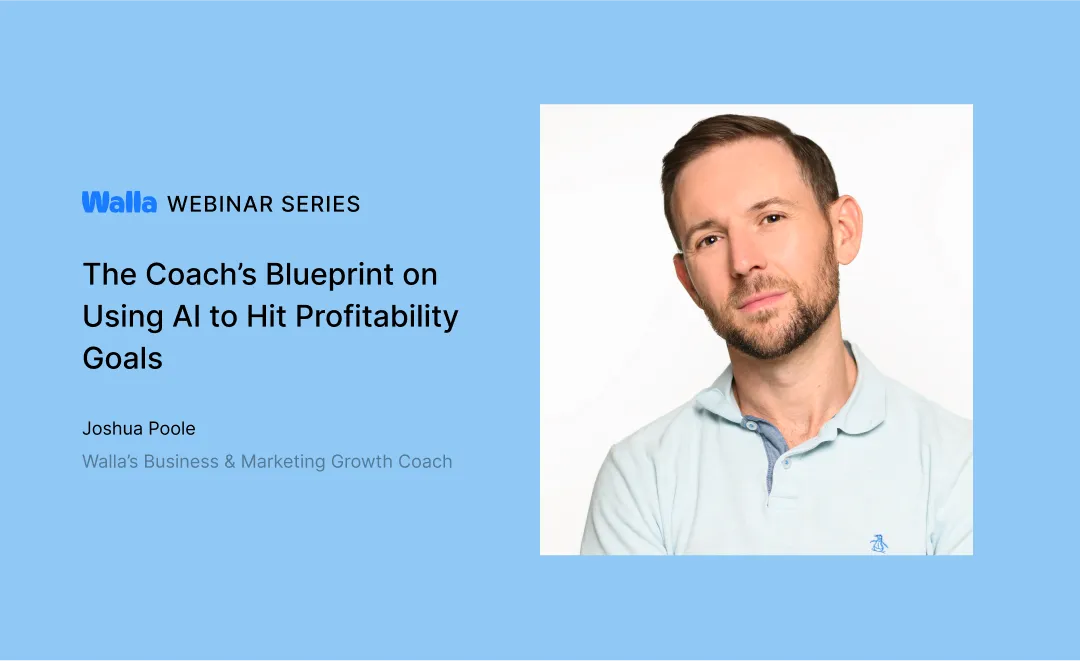
Joshua Poole
Josh is a Strategic Advisor and Business Coach who partners with boutique studio owners and managers to drive measurable business growth. He leverages his real-world expertise—gained as a former Studio Grow consultant and current fitness instructor—to maximize client acquisition, engagement, and retention using the Walla platform. His passion is helping operators truly thrive in the market.
Common questions
Is this webinar free?
Yes. Every Walla webinar is free to attend live and free to watch on demand afterwards. All we ask for is your email address. There is no card and no trial attached.
Do I get the recording if I cannot attend live?
Register anyway. We email the replay to everyone who signed up within a day of the session ending, and it goes into the on-demand library shortly after.
Do I need to be a Walla customer?
No. These sessions are about running a studio, not about our software. Most attendees are on another platform when they join.
Who is this for?
Owners and managers of boutique fitness studios, whether you run one location or several.
Watch next


Stop managing your studio.
See Walla in 5 minutes — no pressure, just an honest look at what changes for your business.